Alliance Members

Back Bay Watershed Association
Eel River Watershed Association
Herring Ponds Watershed Association
Jones River Watershed Association
Neponset River Watershed Association
North and South Rivers Watershed Association
Pembroke Watershed Association
Save the Bay: Narragansett Bay
Six Ponds Improvement Association
Taunton River Watershed Association
Weir River Watershed Association
Westport River Watershed Alliance

Monday, January 20, 2014

Did You Know? Rainbow Smelt Restoration is Underway


by Dorie Stolley, Coordinator and Outreach Manager for Watershed Action Alliance of Southeastern Massachusetts


Rainbow smelt are similar in lifestyle to the mighty alewife and blueback herring. These diminutive forage fish are anadromous - they hatch in freshwater, travel to the ocean to grow to adulthood, then, return annually to their natal waters to reproduce. Once they were widely celebrated throughout coastal Massachusetts in late winter for their savory flavor as hordes were caught, coated in flour, fried and eaten with gusto. Now, only a few tenacious fishermen and their families experience this delight. Overfishing, pollution and dams are a few of the factors to blame for the decline of this once regionally important fish.

Two centuries ago rainbow smelt spawned in rivers as far south as the Chesapeake Bay in Virginia; now their southernmost spawning area is in Buzzard’s Bay in southeastern Massachusetts. Rainbow smelt numbers have been dropping since the 1800’s when people caught them in nets by the thousands during the late winter spawning runs. Harvesting large numbers of fish before they were allowed to reproduce in this manner was blamed for a noticeable decrease in smelt numbers, and in 1868 the Massachusetts State legislature banned the taking of smelt by net during the spawning run. By 1874, all methods of fishing except hook and line were forbidden year-round in all but a few rivers. While some local smelt fisheries reported a rebound, statewide the decline continued right up until 2004 when the National Oceanographic and Atmospheric Administration (NOAA) declared them a federal Species of Concern. Now, work is underway to better understand the reasons for the decline and to restore their numbers across Massachusetts, New Hampshire and Maine.

To restore smelt, their basic spawning needs must be met; these can be summed up in a few words: clean, flowing water. To a rainbow smelt, clean water means very low levels of dissolved contaminants, nutrients and sediment, all of which can kill vulnerable eggs. Flowing water means enough water to swim in, as well as the absence of obstacles, like dams or improperly positioned culverts, which can impede movement upstream to prime spawning areas of fairly fast-flowing, highly oxygenated water.  


When we work to benefit rainbow smelt, we increase the health of a river delivering a myriad of benefits to other wildlife, to humans and to the watershed as a whole. For instance, removing derelict dams allows smelt, river herring and other migratory fish to move along the river, and also can decrease the risk of catastrophic flooding, liability to the dam owner, and mosquito breeding habitat and increase human recreational opportunities. In another example, filtering polluted rainwater runoff from roads before it gets to our streams will increase water quality for all living creatures that live in it or drink it, including people.

The State of Massachusetts is working with New Hampshire and Maine to develop a regional plan to conserve and restore smelt. We can also do our part for smelt, herring and other wildlife that depend on our region’s rivers. Most measures are relatively easy such as leaving streamside vegetation in place or planting streamside trees and shrubs. Other measures provide both cost savings and habitat benefits, such as using minimal fertilizer on lawns and gardens. Asking your town to reduce its use of road salt and sand near streams and supporting the purchase of conservation lands that include spawning streams provide additional benefits.

To make an even bigger difference and add your voice to that of your neighbors, join your local watershed association. These groups are working together to improve water quality, human and ecosystem health, and recreational opportunities.  Find your watershed organization by visiting watershedaction.org.

School of rainbow smelt

Images and information from:
Informative website - http://restorerainbowsmelt.com
Rainbow Smelt Conservation Plan for the Gulf of Maine http://restorerainbowsmelt.com/wp-content/uploads/2013/01/Smelt-Conservation-Plan-final.pdf       

Friday, January 17, 2014

How the Greenhouse Effect Contributes to Winter Woes

By Jonathan Byrne

Reblogged from Cape Cod Bay Watch’s blog. Posted there by Karen Vale on January 13, 2014


Jonathan Byrne writes about the greenhouse effect, a complex natural process that plays a major part in shaping the earth’s climate and ultimately our daily lives. Jonathan is an earth and space sciences teacher at Weymouth High School, and a professional member of the American Meteorological Society. Climate change is one of his passionate interests (see his most recent publication here). 

I recently spent the better part of a December weeknight dislodging my vehicle from a hostile snow bank on Commonwealth Avenue in Boston. My plastic shovel was no match for the glacier beneath my wheels.  Aside from personifying a Don Quixote style quest, I muttered about media outlets and their naive spin about northeast snow storms “Looks like the coast is going to escape the brunt of the storm as the snow is expected to change to rain and cut down on the accumulation”!  Oh sure! Let’s break out the ol’ party favors and celebrate! Then we can all go out and shovel this virtual “ reduced accumulation” of cement before it solidifies and entombs our set of wheels until the spring thaw!  Then afterward we get to whip up a mean cup of hot chocolate and make an emergency appointment with our chiropractor!

As I tirelessly shoveled away my ice weary murmur shifted to the Industrial Revolution and greenhouse gases.  (Say what?)  That’s right! And I don’t mean the “greenhouse” where you might buy Auntie Mabel a cactus for her eightieth birthday. I’m talking about the enhanced greenhouse effect resulting from an atmosphere thickened by the burning of fossil fuels; the liquefied remains of our distant ancestors from Carboniferous period three hundred million of years ago.

So what does all this mumbo jumbo have to do with chipping away at a snow bank on snowy December night in Boston’s Back Bay? I though you’d never ask!
Pull up a chair and follow this chain of cause and effect if you will:  Greenhouse gases have warmed the mean terrestrial surface temperature by approximately 0.8 deg Celsius since the turn of the twentieth century, which has also warmed sea surface temperatures by approximately one degree Fahrenheit (natural cycles such as the Atlantic Multi-decadal Oscillation aside). Now when an old fashioned winter nor’easter comes roaring up the coast, and the winds shifts into the northeast across the relatively warm seas surface waters, the “boundary layer” (lowest several hundred meters of the atmosphere is warmed increasing the probability of a mixed precipitation event i.e. frozen mixed with liquid precipitation especially along the coastal plain.  (One can only ponder, perhaps even shudder over how the Pilgrim Nuclear Power Plant contributes to the warming of Cape Cod Bay through the channeling of billions of gallons of heated water i.e. over 32 degrees above the ambient temperatures filling 3,000 acres of Cape Cod Bay!).
However winter weather woes do not end there. The increased sea surface temperatures also contribute to the intensity of the precipitation through greater instability and evaporation; and also the magnitude of the storm system itself through steepening the temperature difference (or temperature gradient) between the cold sector to the west of the storm track and the warmer marine air to the east.
This in turn, strengthens yet another precipitation producing mechanism called the coastal front, or the convergence boundary between the warmer marine air and the colder air over the interior. This phenomenon typically gives folks living along and west of the route 495 belt bragging rights (or the cursing rights, depending on one’s perspective!) for the heaviest snow accumulations.

Nonetheless another daunting thought crosses my shivering mind as I do my best Ucorn Cornelius impression with my makeshift ice pick:  The downy flakes descending over my shoulders are also the product of a re- expanding polar ice cap.
You heard that right! A touch of the ironic enhances the mystery of the world I say.  We have approximately 53,400 square miles more ice covering Santa’s real estate (i.e. the Arctic) as compared to 2012. In fact according to the IPCC the rate of warming since 1998 has slowed to half the value as compared to the period beginning on 1951 up until 1998. Once again the ocean system is at least partially the culprit. As the Atlantic continues to linger in warm phase, the Pacific is cooling!  The bottom line is climate change is indeed just a little more complicated than spewing a few greenhouse gases into the atmosphere and making the terrestrial environment warm and toasty.
Stay tuned for future blogs from Jonathan.


Visit Cape Cod Bay Watch’s Facebook and Twitter pages for more. 

Wednesday, January 8, 2014

The United (Watershed) States of America!

Today’s Guest Blogger is John Lavey, from Community Builders.

Reblogged from Community Builders’ The Plat Room blog.
THE UNITED (WATERSHED) STATES OF AMERICA
Posted on September 26, 2013 | Author(s): John Lavey →
In a departure from perhaps a more typical blog post here on Community Builders, today I throw on the lenses of historical revisionism to ask a big “what if”. Here goes.
The story begins with John Wesley Powell, the great one-armed adventurer and geologist. He was made famous for his successful runs through the Colorado River in 1869 and 1872. But perhaps his most important legacy rests in a lesser-known deed: Proposing in 1879 that as the Western states were brought into the union they be formed around watersheds, rather than arbitrary political boundaries. This idea rested on the observation that because of an arid climate, a statewide organization decided by any other factor would lead to water conflict down the road. Powerful forces, most prominently the rail companies, were proposing that state’s boundaries be aligned in ways best believed to facilitate agriculture, and thus best be enabled to capitalize off the lands given to them by the Federal Government. But the West, Powell observed, was too dry and its soils too poor to support agriculture at a scale common in the East.

Powell set out to produce a map, shown below, depicting what these “watershed states” might look like. (Take a look at any map of the union today, and you’ll know how successful Powell was). The rail lobby, buoyed by Charles Dan Wilbur and his theory that “rain follows the plough”, successfully swayed congressional opinion to accept state’s boundaries in their contemporary form.

John Wesley Powell’s proposed map of the Western United States, with boundaries according to watersheds.
It’s easy to look at Powell’s 134-year-old idea and see amazing prescience. The potential for water conflict in an arid climate was too important an issue to ignore. As Western irrigators opened up more land for agriculture and development, and as cities and towns grew in population, conflicts over water have indeed become more pronounced. In arid places like the Colorado River basin, where multinational agreements and accords with desert towns require minimum flows be served on a yearly basis, the potential for conflict keeps rising.
Which gets me to my “what if”: What if the Western states were formed around watershed as Powell envisioned? What would that look like and could we speculate on what that might mean for the functioning of modern communities? And since we’re going down that road, let’s ask another what if: What if all of the American states were based around principal watershed, from coast to coast – something even Powell didn’t consider.
Armed with an elementary understanding of GIS and various shapefiles, I set out to create such a map. Some notes on the map itself: It doesn’t look like Powell’s, exactly. Since I decided to take a look at the whole of a country rather than just the arid parts, which includes U.S. possessions on the east coast, boundaries will differ. On top of that, I had access to data that Powell did not; namely Hydrologic Unit Code – HUC –  shapefiles, which depict watersheds from their largest catchment down to very small, creek-level, areas. My priorities for creating this map were to: end up with 50 states; keep larger watersheds intact; try to locate watershed states in roughly the same geography as present-day states; maintain national borders; and try to keep state capitals in each state. Here’s what I came up with:
Watershed states map of the United States of America (updated version). (If you want finer grain detail, which this map includes, click on the image to visit our flickr page) OR go to the new version I posted in Google Earth.
Sure looks different. Besides the obvious changes in land mass and state populations, what else might be transformed if the states were composed this way? Donald Worster, author of the must read “Dust Bowl: The Southern Plains in the 1930’s and Powell biographer, noted in a 2003 interview on NPR that “We would not have, if Powell’s ideas had carried through, any of our huge federal water projects. And we certainly would not have had anything like the massive urban growth that’s taken place in the West.” This is because Powell wanted to organize new Western communities based on the system used by Mormon settlers in Utah, who effectively used irrigation to divert mountain streams, lakes and rivers to their fields. If new Western communities were organized around water and watersheds and used this form of irrigation agriculture, Powell believed, it would force people to use water efficiently, lest overuse or pollution compromise the source. Powell also believed that such an organization would enable communities to be better prepared to stave off attempts by others to seize their water.

“Any city — Los Angeles, for example — would have had to deal with these local watershed groups and meet their terms,” Worster said. “For Powell, the water would not be taken out of the watershed or out of the basin and transferred across mountains … hundreds of miles away to allow urban growth to take place. So L.A., if it existed at all, would have been a much, much smaller entity. Salt Lake City would be smaller. Phoenix would probably not even exist.”
Maybe. Outside the community organizing aspects of Powell’s vision, I think there are some effects we’d see as a nation if only the state delineation idea had survived:
·         Transportation networks could be made more efficient in some places. Low spots in watersheds tend to form the backbone of our transportation systems – roads tend to follow rivers, not ridges. In their present day configuration, state transportation departments sometimes have to maintain roads that they access through adjoining states, or form maintenance agreements with other states to maintain their roads for them. Alta, Wyoming is a good example of this: Its in the Western Teton foothills in Wyoming, but its primary access is via “Ski Hill Road” heading east out of Driggs, Idaho. Locals refer to this situation as “Alta, Wydaho” because it is landlocked from the rest of Wyoming. In the watershed states, that situation no longer exists.
·         The Electoral College would be completely changed. States losing and gaining house members would shift the balance of political power substantially.
·         Land and wildlife management could be streamlined. Because many of these watersheds encompass unique ecosystems, climates and geographies, a watershed states approach could result in more efficient state land management departments better equipped to deal with their particular regional needs.
·         If states were organized around watershed and the idea that water should be used efficiently, then that conservation ethic could also have taken root in the way places were built. Recognizing that it is both fiscally unwise and squandering of agricultural/open space, towns may have grown up with a more compact, mixed use form because of their performance relative to those two benchmarks.
These are a few ideas I have. What do you think?
Had Powell’s vision for the Western states been realized, its tough to say whether the water conflicts this growing nation stands to face would be ameliorated. Human nature is to grow, expand and thrive. We are an inventive and exploratory species, able to create new technologies, new systems and solutions, and become ever more efficient along the way. So much so that it just seems unlikely that population growth and water conflict could be avoided the way Powell envisioned. So while modern day Phoenix would “probably not even exist”, as Worster says, I’d wager that a different version of it would have grown elsewhere.
Moreover, at this stage in our national historic narrative, we are in no position to adjust state boundaries this radically – and while it’s intriguing to write about, it’s not an idea I’m boosting. But perhaps there is the chance that if John Wesley Powell had had his way, communities would have grown up with a different water ethic, one that considered longer term into the future than the next cycle of the plow.
[*11/07/13 UPDATE: I'm working on a series of products that explore this concept further. My first step was to embed the states in Google Earth. You can check that out HERE]

[*11/21/13 UPDATE: I've received a number of requests from a number of different organizations and individuals asking that I perform a similar analysis at multiple scales: What would Europe look like under a 'watershed states" approach? Asia? What about American Counties?  What do we know about the value - we're talking dollars here - of American watersheds?
These ideas are great, and one's I'm very interested in pursuing (contingent the funding to do so).
But there is one idea that I can respond to right now, which is "What would these 'states' look like without adhering to national borders?" In other words, what if I removed one of my "filters" - maintain national borders? This is something I've already done, as a relic of the creation of the original map. So how would THAT look? (hi-res version on our Flickr account, HERE)

Thursday, January 2, 2014

Eco-friendly Ice-Melt for our Wintry New England


Reblogged from the Neponset River Watershed Association blog, originally found on Grist.org.

Common ice-melting products include rock salt (sodium chloride), urea, sand, sand-and-salt mixtures, ashes, kitty litter, calcium chloride, calcium magnesium acetate, magnesium chloride, potassium acetate, and Ice Ban. Mixtures of these products also are used.
Using any of these products has its pros and cons. Some products work better than others at lower temperatures, others are more expensive, some must be frequently applied, and some even make the ground slippery.
Each ice-melting product also impacts the environment differently (i.e., soil, plants, bridges, sidewalks and automobiles). Whereas some products harden the soil and make it too salty for plant growth, others overload it with nutrients or reduce oxygen levels in nearby streams and ponds, endangering animals. Still other products degrade concrete, roadways, bridges and cars.
Learn from Grist.org. Of the “green” ice-melt mixes tested, the productcausing the lease environmental damage contains: Magnesium chloride hexahydrate, calcium chloride (2-3%), potassium chloride (0.5-1%), sodium chloride (0.5-1%).

More information.


This post is from the Neponset River Watershed Association’s NepRWA Blog. The original post can be found at http://grist.org/article/de-salt-of-the-earth/

Saturday, December 21, 2013

A Snowy Owl Update, from Mass Audubon


Reblogged from the Neponset River Watershed Association blog, first posted from a Mass Audubon blog

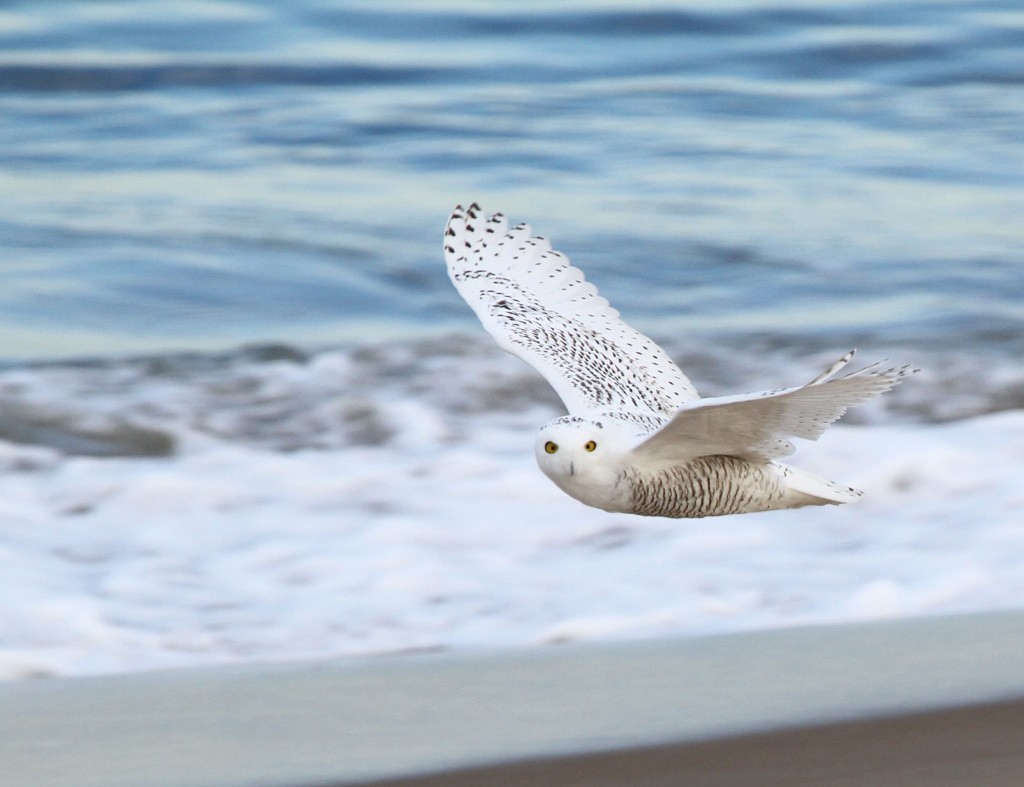
Currently New England is hosting a major incursion of snowy owls, many of which will likely spend the winter in our area.
Snowy Owl copyright David Larson
Photo © Dave Larson
Typically these Arctic visitors tend to appear most frequently near the coast, but the first report this year was inland at Mount Wachusett in Princeton on November 17. Since then, snowy owls have been showing up all over Massachusetts. See a map of recent sightings on eBird.

Why So Many Snowy Owls?
The snowy owl is considered an “irruptive” species—one that responds to changes in the conditions on its home territory by moving elsewhere in search of food.  Some of the factors that may trigger these irruptions include variations in food supply in the Arctic, severe snow and ice cover in their usual wintering areas, or a superabundance of owls resulting from an exceptional nesting season prior to a southward irruption.
For many years it was assumed that snowy owl irruptions only occurred in years when the lemmings that comprise the snowy owls’ primary food in the Arctic were in short supply, thus forcing the starving owls to move south in search of food.
However, Norman Smith, sanctuary director of Blue Hills Trailside Museum and lead of Mass Audubon’s Snowy Owl Project says “We actually see the most snowy owls in New England after an Arctic lemming population boom, not bust.” High lemming populations improve breeding success, and irruptions typically consist mostly of hatch-year birds (ones born this year).

Where to See Snowy Owls
Snowy owls arriving in Massachusetts tend to seek local habitats that mimic the Arctic tundra where they spend most of their lives, such as large salt marshes, extensive agricultural fields, and even airports. Popular sightings include Westport, New Bedford, Nantucket, Orleans, Duxbury Beach, and of course, Plum Island.
Accordingly, if you are passing a large open field this winter, that white spot in the distance might only be an errant piece of plastic, but it could also be a snowy owl!
Reposted from a Mass Audubon blog, posted December 7, 2013 by Hillary. Text by Marj Rine, Photo © Dave Larson


This post is from the Neponset River Watershed Association’s Neponset Nature Blog. The original post can be found at: http://www.neponset.org/happenings/neponset-nature-blog/snowy-owl-update/

Tuesday, December 10, 2013

Did You Know? Clean, Plentiful and Free Flowing Water in 2013 Thanks to Watershed Associations

by Dorie Stolley, Watershed Action Alliance Coordinator and Outreach Manager

With Thanksgiving recently passed and the New Year on its way, it’s a good time to look back over the year and the accomplishments of watershed associations in southeastern Massachusetts, which work for clean, plentiful and free flowing water for both wildlife and people.

Clean Water. This year scores of watershed volunteers across the region participated in cleanup efforts, removing debris that can strangle streams, plastic that can poison fish and people, and old traps and other items that can mutilate or kill wildlife. For example, one hundred shopping carts, 12 bicycles, toilets and tires were hauled out of the choked Neponset River during one day in August. Plastic drink bottles by the hundreds, several lobster traps and innumerable pieces of Styrofoam were gleaned from the mouth of the Eel River in November.  The Butt Brigade was launched in Narragansett Bay to gather data about discarded cigarette butts, which will be used to target solutions for this insidious littering problem.

Volunteers haul a shopping cart out of the Neponset River in August.
Other things that foul our water are less visible. Common pollutants include pesticides, bacteria, and nutrients such as nitrogen and phosphorus, which, in excess, can over fertilize water causing rampant algae and plant growth. The algae can clog waterways, choke out useful plants and even lower oxygen levels causing fish kills.  The biggest nutrient problems come from wastewater treatment plants, leaky sewage systems, and untreated polluted runoff from roads and yards during storms, which also can provide a lot of bacteria. To combat these evils, in 2013 watershed associations worked on a host of projects including installing rain gardens, pushing for better regulations for wastewater treatment plants and proposing less costly alternative to updating septic systems.

Rain gardens not only remove nutrients from runoff, they filter out other pollutants and sediment, which makes them cost effective in the fight to prevent tainted water from entering our streams. A rain garden is strategically placed in a depression near a runoff source, like a road that channels water or the edge of a parking lot. It is planted with deep-rooted native plants, which also beautify the landscape, and must be maintained periodically for best performance.

Westport, MA is enjoying numerous new rain gardens and avoiding the costs of more expensive rainwater runoff treatment techniques because of a partnership between the Westport River Watershed Alliance, the Town of Westport and the Buzzard’s Bay National Estuaries Program. Volunteers contribute to this work, too: for instance, they planted over 500 plants in the rain gardens at the Westport Middle School.

Other ways that watershed associations in southeastern Massachusetts worked to achieve cleaner water included identifying areas where nonpoint source pollution was worst and working with towns to install structural filters, recommending practices for protecting groundwater and Cape Cod Bay for the Plymouth Nuclear Power Plant, and educating residents on how to keep pollutants out of the water, for instance, by cleaning up pet waste and using minimal amount of fertilizer (or none) on lawns.

New sign in Scituate reminding watershed
residents to conserve  water.
Plentiful Water. Not only did watershed associations work to keep water clean, they worked to keep it plentiful. Plentiful water in streams and rivers is necessary for river herring to travel upstream to spawn in the spring. In the summer and fall, the outmigration of young herring from their hatching grounds in freshwater to the ocean where they spend much of each year is dependent on adequate water as well. To this end, in 2013, summer residential water restrictions on alternate days put in place by North and South Rivers Watershed Association once again saved 30,000 gallons per day on First Herring Brook in Scituate. A new sign reminding residents to conserve water during summer months and thanking them for their efforts during times of adequate streamflow was installed along a major travel route.

2013 saw a giant step forward in the decades-long effort to restore adequate streamflow to the Jones River in Kingston. Silver Lake is the headwaters of the Jones, however, the City of Brockton withdraws so much water from it that the stream has not flowed normally for decades to the great detriment of wildlife, particularly aquatic species such as river herring. This year, as part of the Sustainable Water Management Initiative, a grant allowed for a report on water use operations of Silver Lake and the nearby Monponsett Ponds. Its conclusions were that the present use is not sustainable and is detrimentally impacting the ecological health of the river, meaning that more water is needed to flow in the Jones. The completion of this report is an important step in returning enough water to the Jones for fish to flourish and the ecosystem as a whole to thrive.
 
Plantings on the restored stream bank by the former
Whittenton dam in the Taunton watershed.
Free Flowing Water. This year saw much headway on projects to remove outdated dams that block the flow of water, form obstructions to river herring and other migratory fish and trap stagnant water. For instance, in the Taunton watershed, after 170 years in place, the Whittenton dam came down and its waters were released back into the original channel. Within weeks, a crew rebuilt its stream banks and replanted the wetlands. It is the second of three dams along the Mill River to be removed. Once the third is gone, an unprecedented 30 miles of habitat will be opened up to migratory fish like river herring and American Eel. Other benefits of this project are the elimination of the risk of catastrophic flooding from a breach of the dam and new recreational opportunities for residents.


This is just a smattering of all of the work done by watershed associations in 2013. The member organizations of Watershed Action Alliance work for you to protect water resources and the wildlife that depends upon them and to provide opportunities for water recreation. Join your association to support their work. To find your watershed association, visit http://watershedaction.org.